
Corrugated Pallets
for Plastic Packaging
Ecodek pallets are ideal for plastic bottles, closures, molded components and bulk packaging applications, with lightweight construction, clean handling and designs matched to the application.
RIGHT-SIZED FOR PLASTIC PACKAGING
A Natural Fit for Lightweight Products
Plastic bottles, closures and molded components can take up a lot of space without creating an especially heavy load. That makes many plastic packaging applications a natural fit for corrugated pallets.
Rather than using a pallet built for much heavier products, an Ecodek pallet can be designed around the actual load and handling requirements. Using only the material the application needs can reduce pallet cost while keeping strength where it matters.
The result is a cost-effective pallet that is also exceptionally easy to handle once the product has been transferred.
OPEN-CONTAINER HANDLING
Clean Handling for Plastic Bottles
Some plastic bottles and containers are shipped upside down and later inverted into their final orientation at the receiving location.
During part of that process, the bottle openings may face downward toward the pallet.
That makes loose pallet debris a real consideration.
Ecodek pallets contain no nails and eliminate the wood splinters and loose wood fragments associated with damaged wood pallets. Their corrugated construction provides a clean handling platform around open containers without making unnecessary sanitation or sterility claims.
Once the bottles have been transferred or inverted, the low empty-pallet weight also makes the pallet easy for an operator to lift, remove and handle.
FEWER INDIVIDUAL CARTONS
Bulk Packaging for
Closures & Small Components
Caps, closures and other small molded plastic components often lend themselves well to bulk packaging.
Instead of dividing the product among large numbers of individual cartons, thousands of components can sometimes move together in one bulk container. That can reduce repeated packaging material, eliminate space taken up by individual carton walls and flaps, and simplify handling through the distribution process.
GreenLabel has supplied Ecodek pallets for plastic packaging applications for decades. In some long-running programs, the receiving customer has standardized on an existing Ecodek design. When another supplier is added, that supplier may simply be directed to use the same established pallet.
INTEGRATED SYSTEM
Pallet and Tray Designed to Work Together
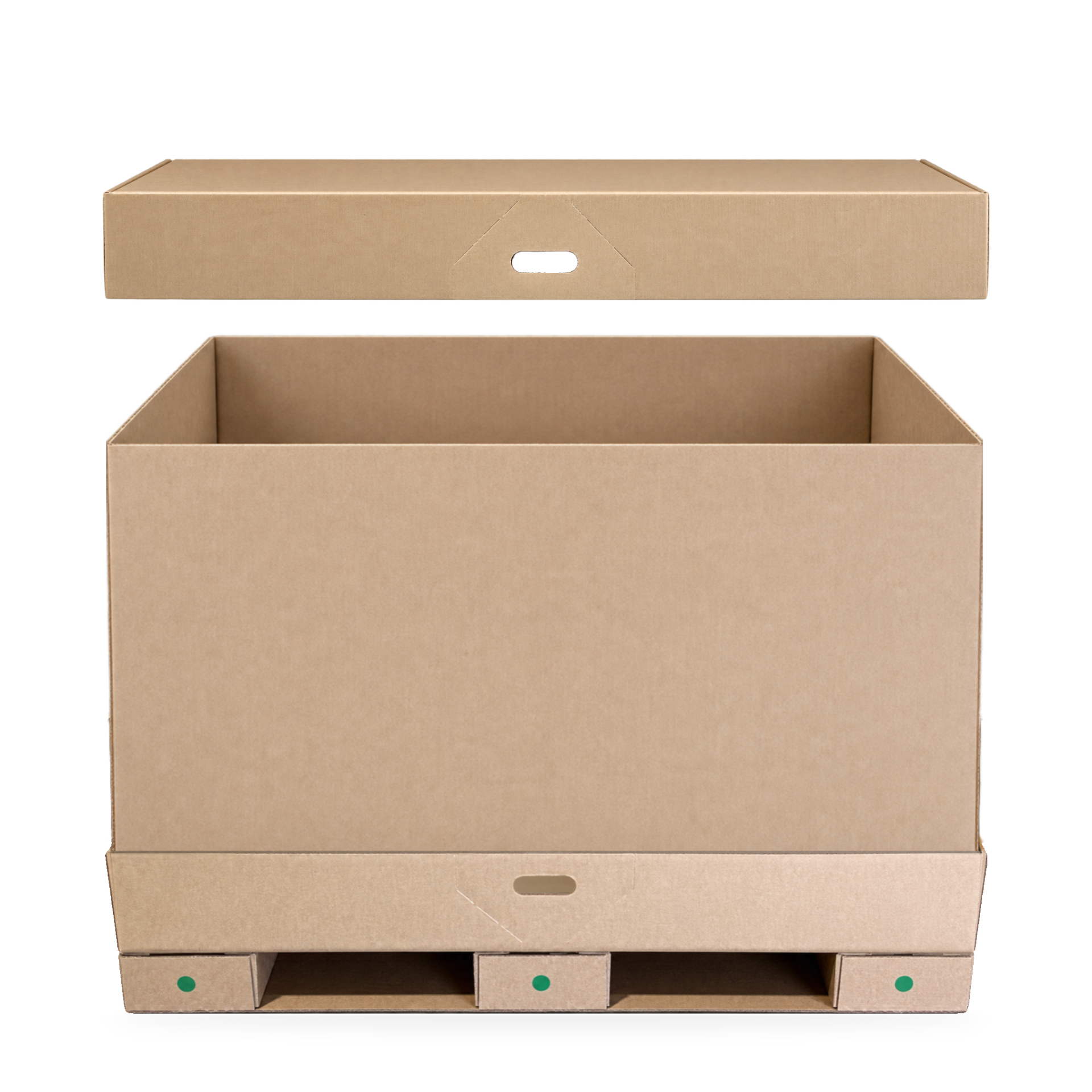
For suitable bulk applications, GreenLabel can manufacture an Ecodek pallet with an integrated infold tray.
The tray is supplied already glued, with the sidewalls folded down for efficient shipment. At the point of use, the long sides are lifted and the infolded ends move into position to form the finished tray.
A corrugated bulk-container body is then placed inside it. Depending on the customer or supplier, that body may also be called a tote or corrugated tube.
GreenLabel does not manufacture the bulk-container body itself. It is typically a simple scored and glued corrugated sleeve that can be produced efficiently by the customer's existing corrugated box supplier.
GreenLabel supplies the pallet, the tray dimensions needed to complete the system and, when desired, a matching loose top tray or lid made alongside the pallet tray.
SHIPPING EFFICIENCY
More Product in the Same Cube
Individual cartons consume space with repeated walls, seams, flaps and gaps between packages.
When the product can instead move efficiently in a bulk container, much of that repeated packaging can sometimes be eliminated, allowing more of the available cube to be used for the product itself.
In one customer application, moving from individual cartons to a GreenLabel bulk-container pallet system increased usable product capacity by approximately 20%.
The pallet and tray components can also ship efficiently before use. In one typical configuration, approximately 500 tray pallets and 500 matching top trays can fit on a full 53-foot trailer.
Frequently Asked Questions
CPG & Bulk Pallets FAQ
What plastic packaging products are a good fit for Ecodek pallets?
Ecodek pallets are commonly used for plastic bottles, containers, caps, closures and other molded plastic components. These products often occupy a large amount of space without creating an especially heavy load, which can make a right-sized corrugated pallet a very efficient choice.
Why are corrugated pallets useful for plastic bottle applications?
In some bottle applications, containers are shipped upside down and later inverted at the receiving location. Corrugated pallets eliminate nails, wood splinters and loose wood fragments from the pallet itself, which can be especially useful when open bottle mouths are facing downward during handling.
Can Ecodek pallets be used for food and beverage packaging applications?
Yes. Ecodek pallets are used as secondary/tertiary transport packaging for products such as bottles, closures and other packaging components that may ultimately be used with food or beverages.
The pallet itself is not intended to be the direct food-contact surface. It is made from corrugated fiber-based packaging materials and functions as the shipping and handling platform beneath the packaged product or bulk container.
For these applications, the advantages are practical: clean corrugated construction, no nails or wood splinters, low pallet weight and a packaging system that can be designed around the customer's handling and cleanliness requirements.
Why does lightweight matter more in plastic packaging applications?
Many plastic bottles, closures and molded components are relatively light for the amount of space they occupy. That can allow the pallet to use less material while still being designed for the actual load. The result can be a lower-cost pallet that is also much easier to lift and remove after the product has been transferred.
What is a tray pallet?
A tray pallet uses an infold tray as the pallet’s top deck. The tray is already glued, and at the point of use, lifting the side walls raises all four sides to form the bottom tray for the bulk container.
The corrugated tube or tote then sits directly inside that tray. Unlike many bulk-container systems, the tube itself has no separate bottom. The pallet’s top tray serves both as the top deck of the pallet and the bottom of the bulk container, reducing the number of separate packaging components.
What is the difference between a tube, tote and bulk container?
The terminology can vary by customer and supplier. In corrugated packaging, the four-sided body may be called a tube or sleeve, while customers may refer to it as a tote. Bulk container is a broader term that can describe the completed package.
In the GreenLabel tray-pallet system, the tube is simply the corrugated sidewall structure. It has no separate bottom. The Ecodek pallet’s integrated tray serves as both the top deck of the pallet and the bottom of the bulk container, while a matching top tray or lid closes the unit.
Because terms such as tote and bulk container are used differently across industries, GreenLabel works from the actual dimensions and packaging requirements rather than relying on terminology alone.
Does GreenLabel manufacture the corrugated tube or tote?
No. GreenLabel focuses on the Ecodek pallet, integrated tray and matching top tray or lid, and provides the dimensions needed for the bulk-container body.
The tube itself can vary considerably in height depending on product quantity, stacking, shipping cube and customer requirements. Because it is a simple scored and glued corrugated sleeve, it is usually most cost-effective to have it produced directly by a corrugator or the customer’s existing box supplier, where the sheet can be trimmed and scored to the exact required size.
That lets each supplier focus on what it does best while keeping the overall system coordinated.
Can GreenLabel provide the matching top tray or lid?
Yes. The same tray design used with the pallet can also be supplied separately as a matching top tray or lid.
Can bulk packaging replace individual cartons?
In suitable applications, yes. Closures, caps and other small plastic components can sometimes move more efficiently in one bulk container instead of being divided among many individual cartons.
Can bulk packaging increase cube utilization?
It can. Replacing many smaller cartons may eliminate repeated carton walls, seams, flaps and gaps between packages. In one GreenLabel customer application, the change increased usable product capacity by approximately 20%. Results depend on the product and the existing packaging configuration.
Can loaded bulk containers be stacked?
Often, yes, but stacking needs to be considered as part of the overall package design. Load weight, container height, product characteristics, pallet design and the corrugated construction of the tube all affect how the completed unit performs when stacked.
My customer is requesting an Ecodek pallet. Can you supply the same design?
Yes. In many plastic packaging programs, the receiving customer is already using an established Ecodek pallet and asks additional suppliers to use the same design.
Send GreenLabel the Ecodek item number, drawing, or other identifying information your customer provided. In many cases, we can identify the existing pallet and supply the same established design without starting a new application-development process.
What information does GreenLabel need to evaluate a new application?
Helpful information includes the product, total load weight, desired quantity per unit, pallet footprint, bulk-container dimensions, stacking requirements, shipping environment and handling method. GreenLabel can then determine whether an existing Ecodek design fits the application or whether a new configuration makes more sense.
Let's Build Around Your Packaging.
Tell us what you’re shipping and we’ll design a corrugated pallet built around your product, your operation, and the way it moves.